ÅAS and student restaurant Kårkaféerna are buying hens for Kåren’s courtyard
Self-sufficiency trends, protein maximisation and rising egg prices are behind the decision to buy hens for Kåren’s courtyard.
As part of the refurbishment of Kåren Gården (Kåren’s yard) – or Kården – ÅAS and Kårkaféerna decided to build a chicken coop, inspired by the one that stood on the Kåren’s lot when it was purchased in 1925.
“We felt it was simply an obvious choice! We’ve noticed that it’s both trendy to consume plenty of protein these days, whilst egg shelves in shops are often empty. Furthermore, several students have expressed an interest in helping to look after the hens on the farm,” comments one of the initiative’s representatives.
The project is expected to contribute to both a stronger sense of community and a more sustainable campus life. The plan is for the hens to start supplying fresh eggs to the Kårkaféerna’s restaurants before the summer, and in the long term also to serve as an educational resource for interested students.
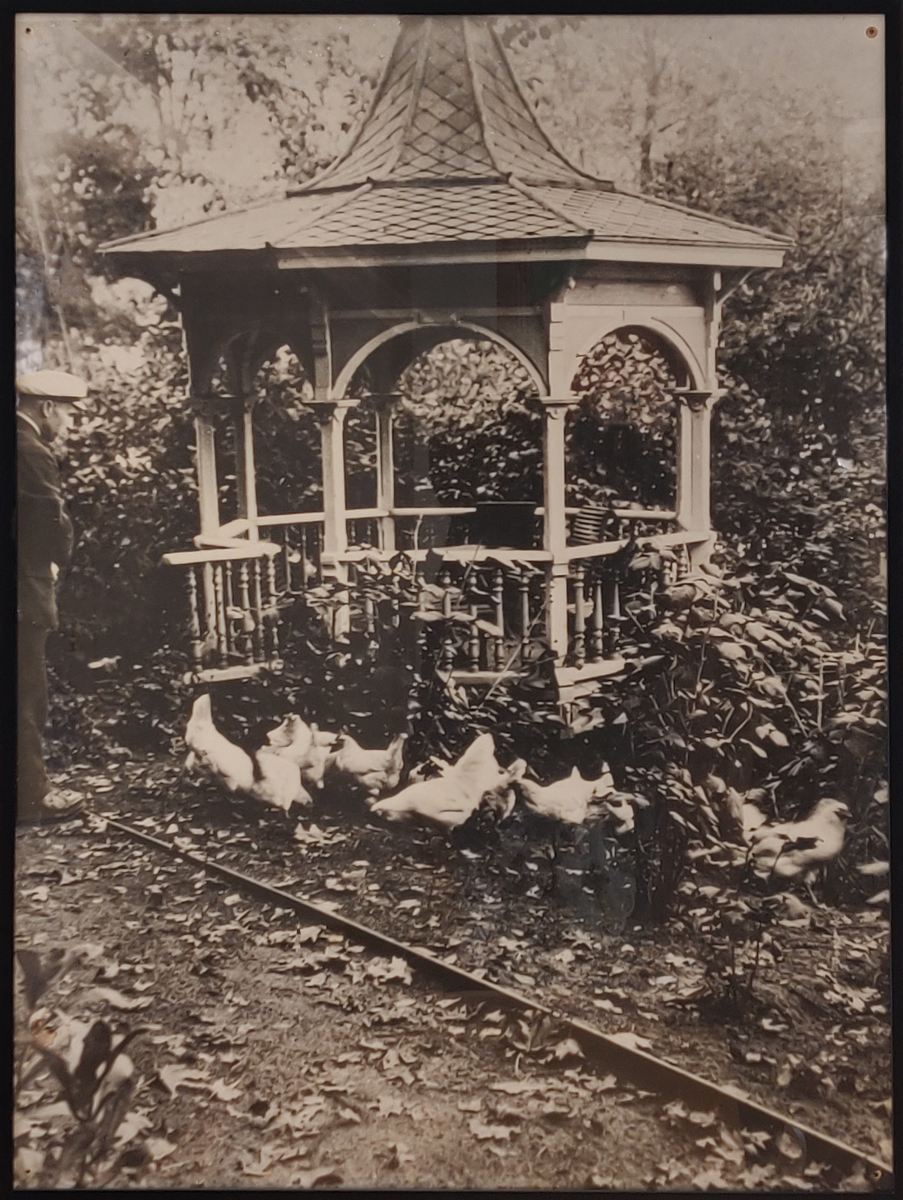
Chicken at Kåren’s courtyard in the 1920s. Photo from ÅAS’ archives.
Want to influence Åbo Akademi University? Apply to be a student representative on the Council of the Department of Natural and Health Sciences!
The Student Union of ÅAU has student representatives on the Council of the Department of Natural and Health Sciences. One more student is needed for the Council. If you are interested in the position – apply on Friday 6 March, the latest. The meetings are held in Swedish and therefor knowledge in Swedish is required.
More information in this news article’s in Swedish version.
The Election Committee has confirmed the results of the 2025 Student Union Council Elections, which took place on 3–6 November. A total of 1033 votes were cast, and despite a record number of candidates, voter turnout was lower than in the previous election in 2023.
At its meeting on 6 November, the Student Union Council Election Committee confirmed the results of the 2025 Student Union Council Election, and drew lots for the candidates who received equal comparison figures. In the 2025 Council Election, 1033 votes were cast, which means that 18,56% of all eligible student union members voted. The voter turnout fell from the previous Council Election in 2023, when the turnout was 23,07%.
“It’s great to see students getting involved in the Student Union Council Elections, even though voter turnout has gone down. All the Electoral Associations got at least one seat, so the Council will have broad representation. I want to thank everyone who voted and, above all, everyone who stood as a candidate”, says Amanda Byskata, Chair of the Election Committee.
FNT-listan received the most votes and seven seats in the Council
A total of 107 candidates from eight Electoral Associations ran in the Student Union Council Elections. The new Council consists of 25 Members of the Council and their Deputies. Their term of office is from 1 January 2026 to 31 December 2027. The new Council will hold its inaugural meeting on 27 November, when it will elect, among other things, the Student Union’s Executive Board for 2026.
FNT-listan list received the most votes (26.7%) and won seven seats in the new Student Union Council. The second most votes went to Gemensamma Vasa (19.9%), followed by MK-listan (18.0%) in third place – both groups won five seats in the Council. Emilia Melén (De Rättvisa) got the most, 41, personal votes in the election.
“I am grateful for the trust placed in me and for being able to continue working for students and the Student Union. Our Electoral Association De Rättvisa did a fantastic job, and I am delighted to have been able to stand for DRV! Becoming a Member of the Council means a great deal to me, and I will do my very best to represent my fellow students.” says Emilia Melén (DRV), the vote magnet in the Student Union Council Elections.
Election results
The final results are shown below. Persons 1–25 are elected Members of the Student Union Council.
| Namn | Electorial Association | Amount of votes | Comparison figures | |
| 1 | Tilde Strömsbäck | FNT-listan | 28 | 276.00 |
| 2 | Julia Aspholm | GV | 35 | 206.00 |
| 3 | Isabel Björklöf | MK-listan | 16 | 186.00 |
| 4 | Kevin Hede | FNT-listan | 27 | 138.00 |
| 5 | Emilia Melén | DRV | 41 | 128.00 |
| 6 | Nea Olli | GV | 24 | 103.00 |
| 7 | Lina Hermansson | MK-listan | 14 | 93.00 |
| 8 | Walter Törnwall | FNT-listan | 27 | 92.00 |
| 9 | Anton Gröning | SF-listan | 28 | 76.00 |
| 10 | Felicia Lindström | FNT-listan | 22 | 69.00 |
| 11 | Kajsa Glader | GV | 23 | 68.67 |
| 12 | Artur Ekman | DRV | 25 | 64.00 |
| 13 | Julia Stenhammar | MK-listan | 13 | 62.00 |
| 14 | Ronja Eklund | DKL-listan | 19 | 58.00 |
| 15 | Ida Puskala | FNT-listan | 19 | 55.20 |
| 16 | Niklas Vaulanen | Rödgröna | 23 | 53.00 |
| 17 | René Närhi | GV | 17 | 51.50 |
| 18 | Emilie Jäntti | LSK | 21 | 50.00 |
| 19 | Tristan Frank | MK-listan | 13 | 46.50 |
| 20 | Rebecca Ahlskog | FNT-listan | 18 | 46.00 |
| 21 | Satu Tahko | DRV | 23 | 42.67 |
| 22 | Emma Vikman | GV | 17 | 41.20 |
| 23 | Erik Malmström | FNT-listan | 16 | 39.43 |
| 24 | Lina Kronström | SF-listan | 19 | 38.00 |
| 25 | Minea Salminen | MK-listan | 12 | 37.20 |
| 26 | Runa Åberg | FNT-listan | 16 | 34.50 |
| 27 | Frida Holgers | GV | 16 | 34.33 |
| 28 | Melina Lindholm | DRV | 10 | 32.00 |
| 29 | Greta Mäkelä | MK-listan | 12 | 31.00 |
| 30 | Daniel Kass | FNT-listan | 16 | 30.67 |
| 31 | Casper Loo | GV | 13 | 29.43 |
| 32 | Jesper Öhman | DKL-listan | 16 | 29.00 |
| 33 | Joel Saarinen | FNT-listan | 14 | 27.60 |
| 34 | Malva Sjöblom | MK-listan | 10 | 26.57 |
| 35 | Niko Sandberg | Rödgröna | 18 | 26.50 |
| 36 | Noomi Talvio | GV | 9 | 25.75 |
| 37 | Sofie Lehtovaara | DRV | 8 | 25.60 |
| 38 | Antonia Holmberg | SF-listan | 16 | 25.33 |
| 39 | Svante Södergård | FNT-listan | 12 | 25.09 |
| 40 | Ronja Fast | LSK | 8 | 25.00 |
| 41 | Viktoria Björn | MK-listan | 9 | 23.25 |
| 42 | Simon Sundström | FNT-listan | 11 | 23.00 |
| 43 | Sonja Niemimaa | GV | 7 | 22.89 |
| 44 | Svea Välimäki | DRV | 6 | 21.33 |
| 45 | Lotta Martin | FNT-listan | 9 | 21.23 |
| 46 | Lotta Nurminen | MK-listan | 8 | 20.67 |
| 47 | Hope Klemets | GV | 7 | 20.60 |
| 48 | Robin Rönnback | FNT-listan | 7 | 19.71 |
| 49 | Linda-Maria Frantz | DKL-listan | 12 | 19.33 |
| 50 | Hannes Ulfvens | SF-listan | 13 | 19.00 |
| 51 | Christel Still | GV | 6 | 18.73 |
| 52 | Axel Bondestam | MK-listan | 8 | 18.60 |
| 53 | Gustav Johnsson | FNT-listan | 7 | 18.40 |
| 54 | Rebecca Aherto | DRV | 4 | 18.29 |
| 55 | Charlotta Ekman | Rödgröna | 5 | 17.67 |
| 56 | Julia Limnell | FNT-listan | 6 | 17.25 |
| 57 | Emilia Lervik | GV | 6 | 17.17 |
| 58 | Dennis Söderling | MK-listan | 8 | 16.91 |
| 59 | Sabina Olin | LSK | 5 | 16.67 |
| 60 | Casimir Ruohomaa | FNT-listan | 6 | 16.24 |
| 61 | Linn Turkki | DRV | 4 | 16.00 |
| 62 | Oscar Tallberg | GV | 5 | 15.85 |
| 63 | Max Kaituri | MK-listan | 8 | 15.50 |
| 64 | Risto Ruohola | FNT-listan | 4 | 15.33 |
| 65 | Julia Kultti | GV | 5 | 14.71 |
| 66 | Jasper Paalanen | FNT-listan | 3 | 14.53 |
| 67 | Rasmus Österlund | DKL-listan | 6 | 14.50 |
| 68 | Eddie Bäckström | MK-listan | 7 | 14.31 |
| 69 | Santeri Kylämäki | DRV | 4 | 14.22 |
| 70 | Liam Söderlund | FNT-listan | 3 | 13.80 |
| 71 | Johannes Perätalo | GV | 5 | 13.73 |
| 72 | Samuel Valjus | MK-listan | 7 | 13.29 |
| 73 | Matti Saarinen | Rödgröna | 4 | 13.25 |
| 74 | Minea Laakso | FNT-listan | 2 | 13.14 |
| 75 | Johnny Lindfors | GV | 4 | 12.88 |
| 76 | Bei Korkiala | DRV | 2 | 12.80 |
| 77 | Robin Holmström | FNT-listan | 2 | 12.55 |
| 78 | Anton Åkerman | LSK | 5 | 12.50 |
| 79 | Tony Bergman | MK-listan | 6 | 12.40 |
| 80 | Aurora Peurala | GV | 3 | 12.12 |
| 81 | Saga Kujansivu | FNT-listan | 1 | 12.00 |
| 82 | Cassandra Ewalds | DRV | 1 | 11.64 |
| 83 | Aada Järvinen | MK-listan | 6 | 11.63 |
| 84 | Oliver Söderström | DKL-listan | 3 | 11.60 |
| 85 | Emilia Grönlund | GV | 2 | 11.44 |
| 86 | Martin Påwals | MK-listan | 6 | 10.94 |
| 87 | Oliver Pimenoff | GV | 2 | 10.84 |
| 88 | Sam Sågfors | Rödgröna | 3 | 10.60 |
| 89 | Sini Piippo | MK-listan | 4 | 10.33 |
| 90 | Nora Jakobsson | GV | 0 | 10.30 |
| 91 | Olivia Landén | LSK | 3 | 10.00 |
| 92 | Wilma Alho | MK-listan | 3 | 9.79 |
| 93 | Benjamin Hjelt | DKL-listan | 2 | 9.67 |
| 94 | Madeleine Lönnqvist | MK-listan | 3 | 9.30 |
| 95 | Tony Rantanen | MK-listan | 3 | 8.86 |
| 96 | Robin Seppälä | MK-listan | 3 | 8.45 |
| 97 | Mi Adolfsson | LSK | 3 | 8.33 |
| 98 | Jacob Rönnberg | DKL-listan | 0 | 8.29 |
| 99 | Maria Smeds | MK-listan | 2 | 8.09 |
| 100 | Valentin Vainio | MK-listan | 2 | 7.75 |
| 101 | Emilia Degerth | MK-listan | 2 | 7.44 |
| 102 | Mikael Lehtinen | MK-listan | 1 | 7.15 |
| 103 | Vilma Sirén | LSK | 2 | 7.14 |
| 104 | Lucia Stenger | MK-listan | 0 | 6.89 |
| 105 | Markus Huurinainen | MK-listan | 0 | 6.64 |
| 106 | Alexander Kruglov | LSK | 2 | 6.25 |
| 107 | Karin Jyrkänkoski | LSK | 1 | 5.56 |
Distripution of seats by Electoral Association
- FNT-listan 7
- MK-listan 5
- GV 5
- DRV 3
- SF-listan 2
- DKL-listan 1
- Rödgröna 1
- LSK 1
| Electoral Association | % of votes | % of seats in the Council |
| FNT | 26,7 % | 28 % |
| GV | 19,9 % | 20 % |
| MK-listan | 18,0 % | 20 % |
| DRV | 12,4 % | 12 % |
| SF-listan | 7,4 % | 8 % |
| DKL-listan | 5,6 % | 4 % |
| Rödgröna | 5,1 % | 4 % |
| LSK | 4,8 % | 4 % |
For more information, contact
Veera Gustafsson
Secretary General, ÅAS
gs@studentkaren.fi
tel. 02 215 4652
This year, the Student Union Council has decided to donate money to the Ärligt talat chat service.
One of the objectives of the Student Union of Åbo Akademi University (ÅAS) is to promote and advocate for the well-being of students. Therefore, the Student Union Council has decided to donate 1500 € to Ärligt talat – a Finnish-Swedish support chat service that offers free, anonymous and professional counselling with a low threshold for young people and young adults. The initiative to choose Ärligt talat as the recipient of the donation came from the Council group Gemensamma Vasa (GV).
“As most people know, many young people need someone to talk to, while healthcare queues are getting longer and longer. That’s why it feels natural to support an service provider that makes it easier and faster to get the help you need. Supporting Ärligt talat is therefore also a way for us to promote students’ mental health and well-being, which is something we at the Student Union stand for and want to do to give all students in Swedish-speaking Finland a chance to get help more easily when they are struggling,” says Member of the Council Herman Björk (GV), who proposed the Ärligt talat chat service as a donation cause.
Ärligt talat offers low-threshold support every weekday
Ärligt talat is a Finnish-Swedish support chat service for young people aged 13 to 29. Through the chat, young people can anonymously, free of charge and easily get in touch with professional counsellors such as psychologists, sex counsellors and social workers. Ärligt talat chat offers low-threshold support for young people struggling with mental health issues, study stress, relationships, loneliness or life questions. The chat is open from Monday to Friday.
“It takes courage to talk about how you feel, so when you are ready to take that step, help should not be far away. We are very grateful for ÅAS’ donation, which helps us to continue offering anonymous and free counselling by professional counsellors. With us, you can chat directly with a psychologist, without a referral or appointment, regardless of where you are in the country. Students can turn to us in both crises and everyday life – remember that you don’t have to be alone with your thoughts,” says Anna Valkeakari, development coordinator for the Ärligt talat chat service.
ÅAS makes an annual donation to an organisation whose activities are in line with the Student Union’s values. The Student Union Council decides each year on the recipient of the donation. By choosing to support the Ärligt talat chat service this year, ÅAS wants to make a concrete contribution to promoting students’ mental health.
As a Communications Specialist at the Student Union of ÅAU (ÅAS), I am responsible for ÅAS’ communication, i.e. everything from newsletters to social media, photography and website development. I work closely with the Board and Staff to support them in creating content themselves. Proof reading texts is therefore also part of my weekly tasks.
It is important that everyday communication runs smoothly
The Board is the public face of ÅAS and makes most of the social media posts very independently, but if you are thinking of applying to the Board and are not comfortable with social media yourself, there is no need to worry; at the beginning of the year, I hold training sessions for the Board so that everyone has the time and opportunity to learn everything from the basics. I will also teach the Board to use WordPress and publish content on the website!
I am also in charge of ÅAS’ internal communication and have held training sessions on, among other things, how Teams and Outlook are used within the organisation, so that everyone has the same opportunities to participate in discussions regardless of location or if they for example have chosen to work remotely on a particular day.
Creating content requires time and planning
The Board is responsible for the Student Union’s day-to-day external communications, which is why we hold weekly communications meetings that all Members of the Board and Staff are invited to attend. At these meetings, we go through the plans for the upcoming posts on social media and on the website, and plan how future content will be realised and created – i.e. who does what, what kind of photos or videos are needed, and when they should be taken or filmed. ÅAS already has a fairly broad collection of different kind of tools that come in handy in content creating, such as a digital system camera, ring light, a stabilising gimbal for phones, and now, as the newest addition, a set of wireless microphones have arrived in both Vasa and Åbo to improve the sound quality of our videos.
For larger events and projects, it is then my turn to take the lead and design material for different communications channels. When the new Board gathers together for the first time, I take photos that I then post on the ÅAS website and a contact poster. I usually take photos of the entire Board at the same time, and it is also possible to take other photos, for example, to send to the media houses with press releases. I enjoy graphic design and have in recent years designed the animals on the Fastlaskiainen (Shrove Tuesday event) overall patches on a drawing tablet. Designing printed material and online guides is also part of my job, so I get to use almost the entire range of Adobe programmes in my work.
Accessibility and inclusion matter
The Student Union’s content must be accessible and inclusive, so these themes are always part of the training sessions I hold. I not only train new Members of the Board, but have also held training courses for Staff, ÅAS’ associations and Student Union Council Members, among others. Accessibility is something I am passionate about and have studied a lot, so it is something I actively promote in my work.
In recent years, ÅAS has become almost entirely bilingual in its communication, and we emphasise that all our members should have equal opportunity to access the information we share on our communications channels. This applies not only to different languages such as Swedish and English, which are the languages ÅAS communicates in, but also to writing and speaking in plain language, using short sentences (which I admit I could improve on myself) and sharing the same information on multiple channels, as not all our members are in social media and may not be reached by the information there.
Different areas of expertise can be combined in the work
As a Communications Specialist at the Student Union of ÅAU, I have been project manager for the acquisition of a new website. My studies in Computer Science came in handy in this project as I facilitated the entire planning process. It was also helpful in communication with the service providers. The project was, of course, carried out in close collaboration with the Board and Staff, who helped by participating in workshops I organised to restructure the navigation bar and by rewriting content in plain language, among other things.
Overall, my job is very diverse and rewarding, and there is always something new to learn and to develop.
Mari Frelander
Communications Specialist
The Student Union of ÅAU
I am employed at the student union as an expert in higher education policy, student social benefits, well-being, and student rights. My job is to support union members, associations, elected representatives of ÅAS, and student representatives in the ÅAU administration. I have held the title of student representative since the job descriptions for ÅAS employees were updated a few years ago. We initially considered calling me an “advocacy expert,” but fortunately decided that sounded too complicated and dry. The title Students’ Rights Expert is more descriptive; I hope it signals that “yes, you as a student should get in touch, and I am happy to help.”
ÅAS advocacy work
ÅAS’s mission is to make students’ everyday lives as good as possible. We, the employees, are here to support the union board and the student council. I work closely with the union board by providing background information on student health, accessibility issues, and national regulations related to education. We often write texts together or make plans for campaigns.
I am involved as the Student Union contact in ÅAU’s Equality Committee and Crisis Support Group, and I also participate in meetings on student well-being and in collaborative groups with the Student Health Care Services.
Decision-making at ÅAU
One of my tasks is to handle the practical aspects of electing student representatives to various groups within ÅAU. I also organize training for the student representatives and answer their questions so that they can influence ÅAU’s decision-making as effectively as possible. The contact and communication between ÅAS and the student representatives is important so that we are all aware of what is being planned and decided at ÅAU. Especially now, when major changes may occur in education and course offerings, it is a priority to maintain close contact with everyone involved in the work.
How the Students’ Rights Expert can support individual students
I assist individual students in problem situations, for example, by finding out which rules apply to courses and examinations at ÅAU or which organizations can support international students. I often participate as a support person for students in meetings with ÅAU staff regarding, for example, suspicions of plagiarism or violations of the rules of conduct. My role is always to view matters from the students’ perspective and to ensure that students’ rights are upheld. This applies both if a course teacher has not followed the ÅAU rules and if a student has not followed the ÅAU rules.
What happens if I get in contact with the Students’ Rights Expert?
It is up to you what happens! I am happy to listen to what you are thinking about and answer questions or provide information, or provide contact details. If you do not want that, we will never take a question further to anyone else. All emails and everything we discuss are confidential.
Petra Lindblad
Students’ Rights Expert at ÅAS
petra@studentkaren.fi
It’s time for the International Students’ Survey! Your answers provide valuable information as to how ÅAS can improve and develop – and by answering the survey you also get a chance to win a 15€ gift card!
In this survey, you can share your thoughts on how you have experienced both your studies and also your student life outside of them! The point of this survey is to hear your thoughts on how we could improve YOUR student life. There are leading questions where you have the possibility to elaborate on your experiences or thoughts – all of which are very important to us.
Your answers provide valuable information as to how we, the Student Union, can improve and develop!
As a part of the survey, we are raffling off 5 gift cards to the K-stores, worth 15€ each. To participate in the raffle, just leave your abo-email address at the end of the survey. Your answers will remain anonymous, even if you choose to participate in the raffle!
Work is currently underway at the departments in preparation for an educational reform. They have been tasked with evaluating the subject clusters and courses within their study programmes. The goal is to have fewer main subject specialisations per programme, fewer minor subjects, and a reduced number of elective courses within each subject cluster. For example, a main subject worth 60 credits should have a clearer structure showing which courses are included.
This work is based on Åbo Akademi University’s (ÅAU) new Strategy for 2025–2030, where one of the main goals is sustainable finances. The aim is to achieve a lower cost level, both within education and within the university’s overall operations.
The departments are currently reviewing how courses and subject clusters are perceived and what improvements can be made, in collaboration with the departmental councils and heads of subject. The departmental councils also include student representatives, but not all subjects have representation. The heads of subject are the professors with main responsibility for a subject. The head of department, who is the department’s chair and leader of the departmental council, carries significant responsibility for how the work is managed. After evaluating the subject structures and reviewing the course offerings, as well as identifying problematic courses, the departments will together develop proposals on how subjects and course clusters can be reorganised and reformed.
The time to influence the decisions is now!
It is now, while changes to study programmes and courses are being planned, that we students have the best opportunity to make a difference. Once decisions are made in spring 2026, it will be more difficult to introduce changes.
For students to understand what is happening and to be able to influence the process, we need access to information about what is being discussed. We at The Student Union of Åbo Akademi University (ÅAS) hope that ÅAU will include students throughout the entire process. Students should be able to submit questions or feedback regarding the work, and departments should include students directly, for example through surveys or question boxes. Students whose subjects are not represented in the departmental councils, as well as international students in English-language programmes, must also be considered.
The timeline is as follows
- In December 2025, the departments will present their proposals for revised study programmes.
- In February 2026, the Education Council will consider the proposals and take a position on ÅAU’s educational responsibilities.
- During March–April 2026, the ÅAU Board will make final decisions regarding the university’s educational responsibilities.
- From 2027 onwards, ÅAU plans to implement the new educational structures, but for now, preparatory work and situation reviews are underway at the departments.
To make it easier for students to provide input, ÅAS has created its own Question Box. Regardless of whether your department sends out its own survey or not, you can use ÅAS’ Question Box to submit feedback on courses, major subjects, minor subjects, or entire study programmes. You can also ask questions about the educational reform work in general. All feedback received will be forwarded to the departments.
It is important that we students make our voices heard about what we know best – our studies. We are the ones who know our study programmes best, as we are the ones following them and completing the courses. Therefore, it is essential that our perspective is placed at the centre and has an influence on the decisions being made.
As we are now looking for a new Board for 2026, this year’s Board will write short blog posts about their areas of responsibility and tell you a little more about what working in the Board entails.
Hi! Noomi here!
This year I’ve been working with Communications and City Relations in Vasa. When I applied to the Board, I already knew that Communications was the position I was most interested in. As the person responsible for Communications and City Relations, I knew I would get to work with things like social media (although it’s still the responsibility of all Members of the Board to create content for the social media channels we use) and to build connections with, among others, the City of Vasa and the other student unions.
Communications this year!
This year, my tasks have involved being responsible for Communications and City Relations in Vasa. In practice, this position is very much about keeping track of what’s happening in Vasa. I also contribute by creating, among other things, social media content for the Vasa section.
Another important part of the communications role is maintaining contact with the City of Vasa. This has involved meeting with representatives from the city and from Vasek to discuss what matters most to students in Vasa, and how to encourage them to stay in the city after completing their studies. In other words, how to make Vasa a more attractive city.
The Member of the Board responsible for Communication also works closely with the person responsible for Student Culture at various events organised by ÅAS in Vasa. Examples of these events include Fastlaskiainen (Shrove Tuesday event) and the hatting ceremony during May Day celebrations. This work often involves communicating information about the event and taking photos during the event for future social media use on ÅAS’ account.
Another important task that the person responsible for Communications has had is to work with the people responsible for student advocacy. A practical example of this is organising meetings with the Dean and maintaining contact with the advocacy team in Åbo.
What will the position look like next year?
Because of the Board’s restructuring next year, Communications and City Relations will no longer exist in the same form. These responsibilities will be divided among those Members of the Board whose area of responsibility will be Student Culture or advocacy. However, it’s important to remember to maintain contact with, among others, the city and to continue promoting Vasa’s perspective.
Board work is fun and rewarding – and now you have the chance to apply for next year’s Board!
Working on the Board has been both fun and rewarding. A practical example is that you get to learn what a job within an organisation looks like in reality. One of my favourite memories from the Board’s work was handing out roses to ÅAU Staff, which is something the Board does every year. The purpose of giving out roses is to show appreciation for people who are important to the students. Being able to hand out the flowers and see the reactions of those people was both very enjoyable and deeply meaningful.
In summary, I can highly recommend applying for the Student Union Board in Vasa next year! It is a role where you can be creative, make contacts and influence how ÅAS is seen and heard in Vasa.
Noomi Talvio
Member of the Board responsible for Communications and City Relations (Vasa)
The Student Union of ÅAU
As we are now looking for a new Board for 2026, this year’s Board will write short blog posts about their areas of responsibility and tell you a little more about what working in the Board entails.
Hi, it’s Emilia!
I have been Chair of the Board this year and would therefore like to share a little about what it has been like for me. It has truly been an eventful and educational year!
The main task of the Chair of the Board is to plan and lead the work of the Board. This includes delegating tasks, following up and, when necessary, assisting the other Members of the Board in their work. The Chair also acts as the manager of the ÅAS secretary general, who in turn is the Head of the ÅAS’ Staff.
The Chair oversees and coordinates the Board’s activities
The Board works together within its various sectors, and they work closely with the staff. The sectors we currently have at the Student Union are advocacy of interests, student culture, corporate cooperation and communication.
The Board has ongoing tasks within the sectors that recur every year, but each Board also works on the basis of an action plan that contains projects and focus areas specific to that particular year. The action plan specifies the goals and guidelines that govern the Board’s work. This year, for example, we have worked with local elections, meaningful membership, a member survey and the renewal of ÅAS’ strategy, which is something I myself have worked a lot on. Much of the planning, delegation, and follow-up for which the Chair is responsible therefore revolves around the strategy and ongoing activities.
Meetings provide structure in everyday life
A key task for the Chair is to plan ahead and create structure in the Board’s work. This includes preparing and leading various meetings. The Board has board meetings every other week, where the focus is on financial decisions, follow-up of activities, project planning, and the selection of people for various assignments.
In addition to the board meetings, other meetings are also held during the week. The week usually begins with a joint meeting with the entire student union office, where we discuss current issues, and ends with a recap meeting for the Board. The Board also holds sector-specific meetings during the week together with Staff, in which the Chair usually participates. On weeks when we do not have board meetings, we usually hold workshops with the Board on current issues – such as statements, division of responsibilities or ongoing projects.
A broad network is important for advocacy work
As Chair, one of the most important tasks is to maintain a network of contacts with various actors who influence students’ everyday lives. This involves collaborating with other student unions, politicians, partners and many others.
One of the most important contacts you maintain as Chair is with Åbo Akademi University (ÅAU). A large part of the job is to ensure that the Student Union’s advocacy at the university is carried out in close cooperation with the ÅAU’s management. You have regular meetings with the Rector, Vice-rectors, Deans and Heads of Department, where you have the opportunity to raise and discuss current issues affecting students. You also meet regularly with the Head of Educational Services, as this unit is responsible for many functions that affect students’ everyday lives.
This year, in my role, I have also had a lot of contact with the Communications Unit at ÅAU. This has involved communication with students, coordination of information sessions, discussion sessions, and answering questions in connection with the restructuring. In my opinion, this has been one of the most important things I have done this year. Students have the right to know what is happening at their university, and their voices should be heard!
Student traditions come with festive duties
As Chair of the Board, you will also give speeches at various traditional events and academic ceremonies, which are usually fun and memorable. For example, as Chair, you will give speeches during the ÅAS’ cap ceremony on May Day Eve and at the enrolment ceremonies in Åbo and Vasa.
Being Chair of the Board is a fun and incredibly rewarding assignment where you get to learn a lot and help influence the everyday student life of students.
Emilia Melén
Chair of the Board
The Student Union of ÅAU